



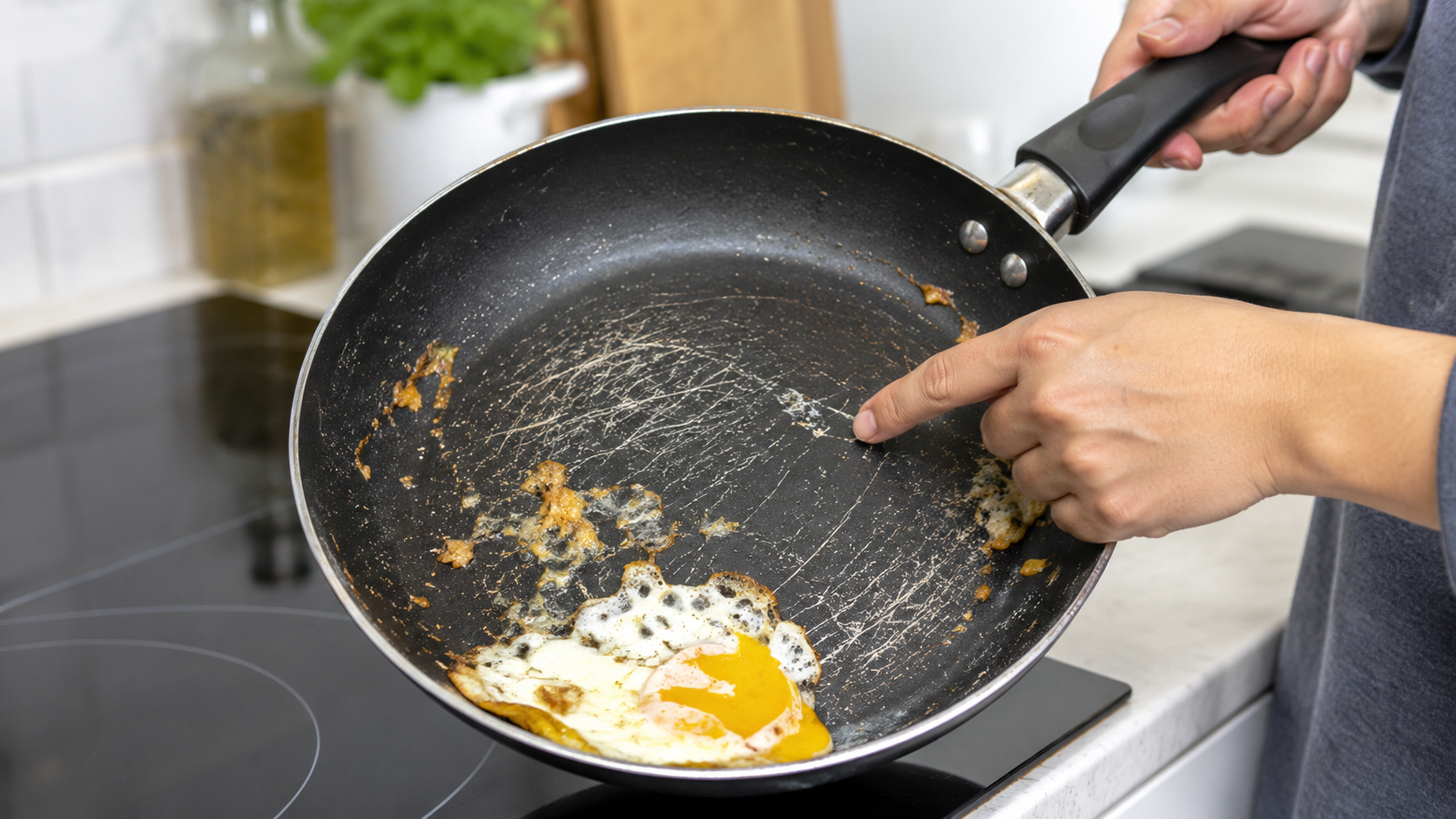
Damaged non-stick coating: is it still safe to use the pan?
Minor scratches are not a reason to throw away a frying pan. If the coating is intact and not peeling, you can continue to use it. There are specific signs when you should stop cooking: peeling, blistering, or chunks of coating in your food. If you see even one of these, set the pan aside.
Why does non-stick coating deteriorate?
A non-stick coating is a thin layer of polymer based on PTFE (Teflon). It prevents food from sticking and is easy to wash, but it wears out even with careful use. The most common causes are:
- metal spatulas, spoons, and forks;
- overheating — especially an empty frying pan on the stove;
- metal sponges and abrasive cleaning agents;
- washing in a dishwasher;
- storing stacked without protective pads.
How to determine how serious the damage to the pan is
Not every scratch is a cause for concern. There is a big difference between cosmetic defects and damage that makes it undesirable to cook.
Level 1 — Minor scratches
Thin lines on the surface. The coating is not coming off, and food does not stick more than usual. You can use it, but you should switch to wooden or silicone utensils.
Level 2 — Noticeable wear
The coating turns gray, loses its shine, and becomes rough. Food starts to stick little by little. The pan is still functional, but this is a signal to think about restoring the frying pan’s coating.
Level 3 — Peeling or blistering
The coating lifts or separates from the base, edges are peeling, and dark spots appear. Other signs may also be present: exposed metal that has begun to darken or rust, or an unusual smell when heated. You should not cook on such a pan.
Level 4 — Coating coming off in chunks
Pieces of the coating are visible in food or on the bottom during cooking. You must not use such a pan.
Is it dangerous to cook on a damaged non-stick pan?
A PTFE coating in a stable state is considered chemically inert. With proper use — without strong overheating or peeling — health risks are minimal.
Problems arise in two situations. First — overheating: if you heat an empty frying pan on high heat for a long time, the coating may begin to degrade. During normal cooking on medium heat, this usually does not happen — the greatest risk arises if you keep empty cookware on maximum heat for several minutes. Second — peeling: pieces of the coating get into the food.
If the coating is intact and the pan is not overheated, the risks are minimal. If it starts to peel off, this is a signal not to continue.
When pan repair is possible: conditions for restoring the coating
Damaged non-stick coating can be restored in many cases — and it is cheaper than buying a new one, especially if the cookware is high-quality.
Restoration of frying pans is possible if:
- the base is intact, without deformations and large dents;
- the walls are not too thin;
- handles and plastic parts are removable — they will not withstand production temperatures;
- the material is aluminum, cast iron, or stainless steel.
If you have a high-quality frying pan — De Buyer, Tefal, Bergner — and the coating has worn off over time or due to improper care, restoration will cost significantly less than a new one. If it is a cheap one with thin walls, sometimes it is easier to replace it.
Many people search for “pan repair” and don’t know what it actually is: the old layer is removed, a new one is applied, and it is baked at production temperatures. The result is as good as new.
When restoration makes no sense
It is better to replace it if:
- the base is bent or deformed;
- there are cracks or through-damage;
- handles are permanently mounted and cannot be removed;
- the walls are very thin — there is a risk of deformation when heated;
- the pan is cheap, and the cost of restoration approaches the price of a new one.
Typical mistakes with a damaged pan
- Continuing to cook when the coating is already peeling. Pieces get into the food, and exposed metal areas come into contact with the ingredients.
- Cleaning with a metal sponge. It destroys the coating much faster than regular wear. Even a few such cleanings significantly shorten the service life.
- Overheating an empty pan. Putting it on the stove and walking away is one of the fastest ways to destroy the coating.
- Washing it immediately under cold water after cooking. A sharp temperature drop can contribute to microcracks. Let it cool down.
- Storing it stacked without pads. Frying pans constantly scratch each other. After a year or two, there is noticeable wear.
- Thinking that any pan can be restored. A deformed base or non-removable plastic parts are limitations under which repair is either impossible or impractical.
- Ignoring warning signs. An unusual smell, blistering, or peeling is not just cosmetic. Continuing to cook at this moment is a bad decision.
What to do right now if you see damage
- Examine it in daylight. Tilt the pan at different angles — this is the best way to see damage that you don’t notice under kitchen lighting.
- Take photos of the problematic areas. Inside, outside, and close-up — this is enough for a preliminary assessment without a visit.
- Remove the handles if they are detachable. Before handing it in for restoration, they must be removed — they will not withstand production temperatures.
When to contact Novaflon
If the coating has started to come off — take a photo and write to us on Viber or Telegram. At Novaflon, we will tell you immediately if we can accept such cookware, how much it costs, and when it will be ready. Timeframes are from 2 to 7 working days. Payment is upon receipt.
Frequently Asked Questions
Can I cook with a scratched frying pan?
Minor surface scratches are not critical if the coating remains intact. If the coating starts to peel, it is better to stop using the pan and set it aside for assessment.
If a piece of the coating gets into food, is it dangerous?
PTFE is considered chemically inert and is generally not absorbed by the body. However, if the coating is peeling off in pieces, this is a sign that the frying pan should be restored or replaced.
Why has food started to stick even though the coating looks normal?
Non-stick properties can gradually decrease even before visible damage appears. Micro-scratches, general wear, and residue caused by improper washing can all affect the surface. If food starts to stick, the coating is no longer in ideal condition.
Can I restore the non-stick coating at home?
No. Sprays and oils only temporarily mask the problem. Restoring a frying pan is an industrial process that involves applying a new coating and curing it at production temperatures. This process cannot be replicated at home.
How long does it take to restore a frying pan?
Restoration usually takes from 2 to 7 working days. The exact timeframe depends on the type and condition of the cookware.
Which frying pans are not accepted for restoration?
Frying pans with non-removable parts, a deformed base, or very thin walls may not be suitable for restoration. Send us a photo, and we will provide a preliminary assessment.
How should I prepare a frying pan for restoration?
Remove the handles, wash the frying pan, and dry it completely. No additional preparation is required.